

I just finished Four Hands, Two Sonatas, and while I enjoyed it, I can’t say it left me completely satisfied. Maybe watching Five Fingers first had something to do with it. Both dramas play with similar ideas: musical talent, family pressure, rivalry, and the need to be recognized by the people who are supposed to love you. But while Five Fingers takes those ingredients and turns them into an emotional torture chamber, Four Hands, Two Sonatas feels like a much lighter version of the same concept.
That’s not necessarily a bad thing. Not every drama needs to destroy us in thirty episodes. The problem is that this one seemed to have a darker story hiding underneath the surface, and I kept waiting for it to go somewhere deeper.
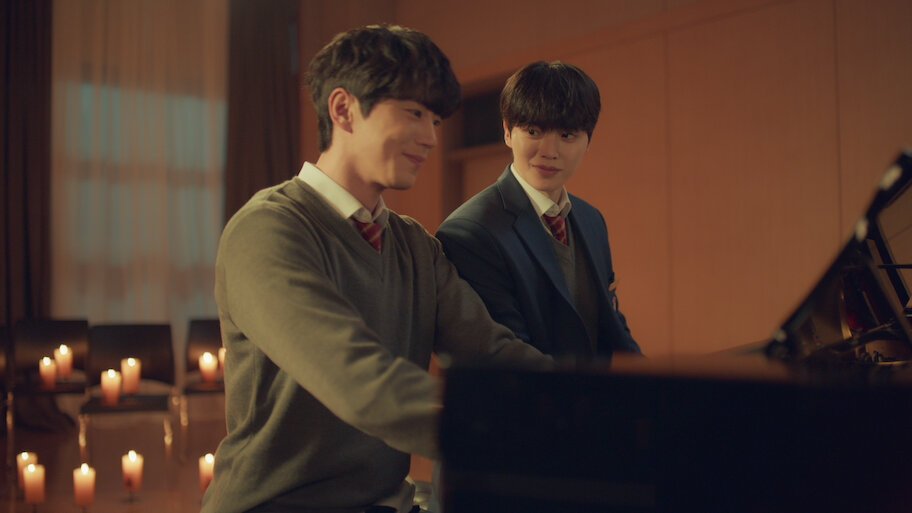
The Story
Four Hands, Two Sonatas brings together young musicians whose talent, ambitions, and family relationships become increasingly complicated. Music is at the center of their lives, but so are expectations, jealousy, and the constant need to prove themselves to others.
The premise gives the drama plenty of room to explore the ugly side of competition and the damage that family approval can cause. Unfortunately, I don’t think it makes the most of that opportunity. Some conflicts feel as though they should have much more weight than they actually receive, and a few loose ends left me wondering whether I had missed something along the way. Plenty of loose ends…
The biggest issue for me is the way the drama handles its darker elements. Some characters do things that are far from harmless, yet the story resolves much of the tension with a lightness that doesn’t quite match the severity of what has happened. I didn’t need another Five Fingers (cause it already is a masterpiece), but I did expect the story to dig a little deeper into its own conflicts.
Characters & Cast
Song Kang’s character was one of the things I struggled with the most. He is essentially a kid looking for his grandfather’s approval, while his mother is just as invested in getting that recognition for him. There is something interesting in that dynamic, but the character himself felt oddly lukewarm to me. I’m not saying Song Kang did a bad job (at all, cause he’s great!); I just don’t think the character has the depth or intensity the story seems to suggest he should have. Once again, everything feels a little too light.
Yoon Se Ah, on the other hand, plays the character who brings much of the drama’s nastier energy. But I kept asking myself: why is she that bad? Her hostility feels disproportionate, especially when so much of it seems to revolve around someone simply being better than her son. I spent a good part of the drama expecting a deeper reason behind all that hatred. Without getting into spoilers, I think the story could have done a better job of making her motivations feel as compelling as her actions.
Lee Jun Young is always excellent. He has a way of making his characters engaging, and he was one of the strongest points of the drama for me. Even when the story itself doesn’t go as far as I would have liked, he manages to bring something to the screen that keeps me interested.
As for Jang Gyu Ri, her character is part of the supporting cast, and I would have liked the drama to make better use of some of the possibilities surrounding its characters. There is enough material here for a more layered story, but not all of it gets the attention it deserves.
Conclusions
I enjoyed Four Hands, Two Sonatas, but I kept feeling that it could have been so much more. The musical setting and the family dynamics offer plenty of potential, and the drama has some interesting ideas about talent, jealousy, and the need for approval. What it lacks, in my opinion, is the willingness to really explore the consequences of its characters’ choices.
Compared with Five Fingers, it is a much softer experience. The characters don’t leave the same mark, the conflicts don’t always have the impact they should, and the resolution feels a little too forgiving considering everything that came before.
It’s a perfectly watchable drama, and I don’t regret spending my time on it. But if you’re expecting the kind of carefully constructed characters and emotional intensity that made Five Fingers so memorable, you might end up feeling the same way I did: entertained, yes, but not entirely convinced.